Les calculatrices électroniques non imprimantes avec entrée unique par clavier sont autorisées.
Les calculatrices permettant d'afficher des formulaires ou des tracés de courbe sont interdites.
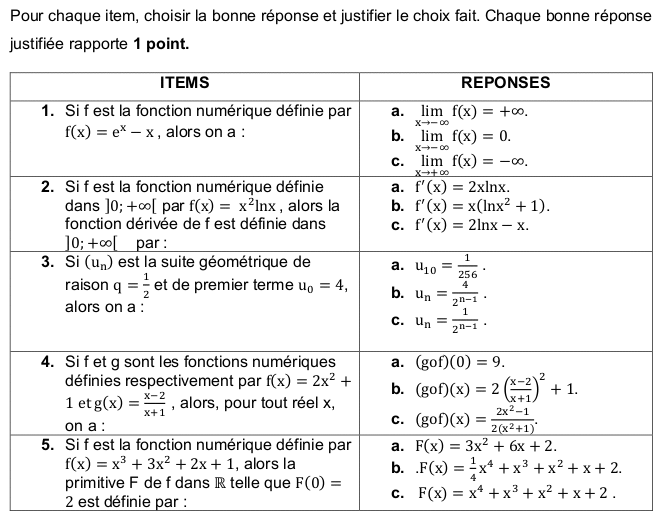
Item 1. - Réponse a.
Si est la fonction numérique définie par , alors on a : .
En effet,
Item 2. - Réponse b.
Si est la fonction numérique définie dans par , alors la fonction dérivée de est définie dans par : .
En effet, pour tout ,
Item 3. - Réponse a.
Si est la suite géométrique de raison et de premier terme , alors on a : .
Le terme général de la suite est de la forme .
Dès lors, nous obtenons :
Nous en déduisons que :
Item 4. - Réponse c.
Si et sont les fonctions numériques définies respectivement par et , alors, pour tout réel , on a :
Item 5. - Réponse b.
Si est la fonction numérique définie par , alors la primitive de dans telle que est définie par : .
Nous savons que est une primitive de si et seulement si .
Montrons que la réponse a) n'est pas correcte.
En effet,
Donc la réponse a) n'est pas correcte.
Montrons que la réponse b) est correcte.
En effet,
Donc la réponse b) est correcte.
5 points
exercice 2
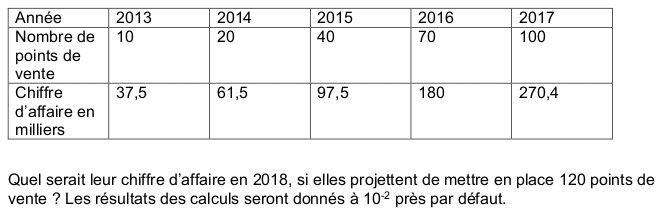
Le tableau suivant donne l'évolution du chiffre d'affaire de la petite unité de fabrication de savons en fonction du nombre de points de vente, après cinq années d'activité.
Nous devons estimer quel serait leur chiffre d'affaire en 2018 s'il est mis en place 120 points de vente.
Déterminons une équation de la droite de régression de en par la méthode des moindres carrés.
Complétons le tableau précédent.
Calculs complémentaires.
Dès lors, nous obtenons :
L'équation de la droite de régression linéaire est de la forme
Par conséquent, une équation cartésienne de la droite de régression de en est
Selon ce modèle, estimons quel serait leur chiffre d'affaire en 2018 s'il est mis en place 120 points de vente.
Dans l'équation de remplaçons par 120 et calculons la valeur de
Nous en déduisons que s'il y a 120 postes de vente en 2018, le chiffre d'affaire de l'entreprise est estimé à environ 314 330 (F?) - l'unité monétaire n'est pas précisée dans l'énoncé.
10 point
probleme
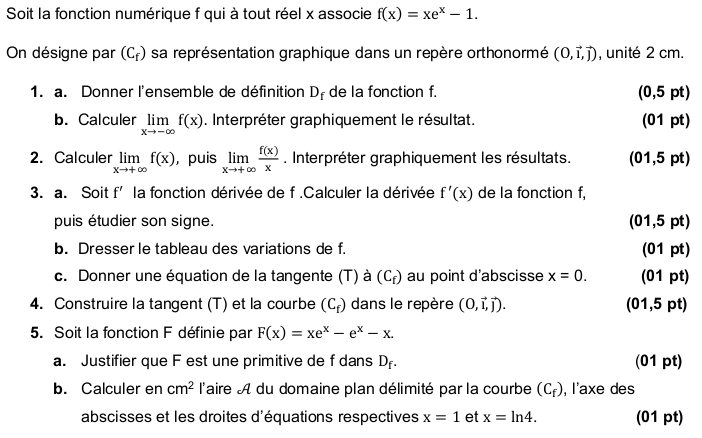
Soit la fonction numérique qui à tout réel associe .
On désigne par sa représentation graphique dans un repère orthonormé , unité 2 cm.
1. a) Nous devons donner l'ensemble de définition de la fonction .
Aucune condition n'est imposée sur .
Donc .
1. b) Nous devons calculer et interpréter graphiquement le résultat.
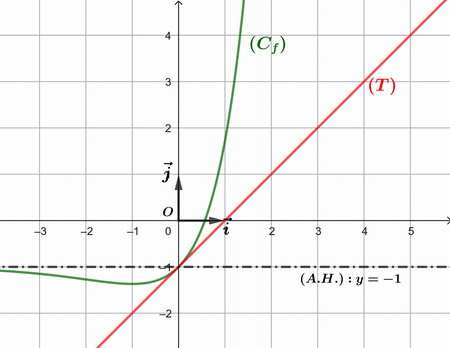
Graphiquement, nous déduisons que la courbe admet une asymptote horizontale au voisinage de d'équation .
2. Nous devons calculer , puis et interpréter graphiquement les résultats.
Graphiquement, nous déduisons que la courbe admet une branche parabolique de direction l'axe des ordonnées.
3. a) Soit la fonction dérivée de . Nous devons calculer la dérivée de la fonction , puis étudier son signe.
Pour tout réel ,
L'exponentielle étant strictement positive sur , le signe de est le signe de .
Nous obtenons ainsi le tableau de signes de .
Par conséquent,
si , alors si , alors .
3. b) Nous devons dresser le tableau des variations de .
3. c) Nous devons donner une équation de la tangente à au point d'abscisse .
L'équation de cette tangente est de la forme soit de la forme
Or
D'où une équation de la tangente à au point d'abscisse 0 est
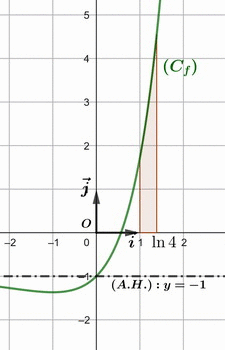
4. Nous devons construire la tangente et la courbe dans le repère .
5. Soit la fonction définie par .
5. a) Nous devons justifier que est une primitive de dans .
La fonction est dérivable sur .
Pour tout ,
Par conséquent, est une primitive de dans .
5. b) Nous devons calculer en cm² l'aire du domaine plan délimité par la courbe , l'axe des abscisses et les droites d'équations respectives et .
La fonction est strictement croissante sur l'intervalle (voir question 3. b)
De plus,
Nous en déduisons que la fonction est positive sur l'intervalle
Donc l'aire demandée se calcule en unité d'aire par .
Or l'unité de longueur est 2 cm et par suite, l'unité d'aire est 4 cm².
Par conséquent, l'aire demandée est égale à , soit .
Merci à Hiphigenie et maloi pour l'élaboration de cette contribution.
Publié par malou
le
ceci n'est qu'un extrait
Pour visualiser la totalité des cours vous devez vous inscrire / connecter (GRATUIT) Inscription Gratuitese connecter
Merci à Hiphigenie / malou pour avoir contribué à l'élaboration de cette fiche
Désolé, votre version d'Internet Explorer est plus que périmée ! Merci de le mettre à jour ou de télécharger Firefox ou Google Chrome pour utiliser le site. Votre ordinateur vous remerciera !


 est la fonction numérique définie par
 =\text e^x - x }) , alors on a :
, alors on a :  = +\infty} }) .
.
= +\infty \\\overset{ { \white{ . } } } { \phantom{ \begin{cases} \lim\limits_{x\to -\infty}\text e^x= 0 \\ \lim\limits_{x\to -\infty}x= -\infty \end{cases}}\quad\Longrightarrow\quad \boxed{ \lim\limits_{x\to -\infty}f(x)= +\infty} } )
![\overset{ { \white{ . } } } { ]0\;;\;+\infty[ }](https://latex.ilemaths.net/latex-0.tex?\overset{ { \white{ . } } } { ]0\;;\;+\infty[ }) par
par =x^2\ln x }) , alors la fonction dérivée de
, alors la fonction dérivée de =x(\ln^2x+1)} }) .
.![\overset{ { \white{ . } } } { x\in\,]0\;;\;+\infty[ }](https://latex.ilemaths.net/latex-0.tex?\overset{ { \white{ . } } } { x\in\,]0\;;\;+\infty[ }) ,
,=\Big(x^2\ln x \Big)' \\\overset{ { \white{ . } } } { \phantom{ f'(x)}=(x^2)'\times \ln x +x^2\times (\ln x)'} \\\overset{ { \white{ . } } } { \phantom{ f'(x)}=2x\times \ln x +x^2\times \dfrac 1x} \\\overset{ { \white{ . } } } { \phantom{ f'(x)}=2x\ln x +x} )
![\\\overset{ { \white{ . } } } { \phantom{ f'(x)}=x\times(2\ln x) +x} \\\overset{ { \white{ . } } } { \phantom{ f'(x)}=x\times\ln x^2 +x} \\\overset{ { \white{ . } } } { \phantom{ f'(x)}=x(\ln x^2 +1)} \\\\\Longrightarrow\quad\boxed{\forall\,x\in\,]0\;;\;+\infty[,\quad f'(x)=x(\ln x^2 +1)}](https://latex.ilemaths.net/latex-0.tex? \\\overset{ { \white{ . } } } { \phantom{ f'(x)}=x\times(2\ln x) +x} \\\overset{ { \white{ . } } } { \phantom{ f'(x)}=x\times\ln x^2 +x} \\\overset{ { \white{ . } } } { \phantom{ f'(x)}=x(\ln x^2 +1)} \\\\\Longrightarrow\quad\boxed{\forall\,x\in\,]0\;;\;+\infty[,\quad f'(x)=x(\ln x^2 +1)} )
 }) est la suite géométrique de raison
est la suite géométrique de raison  et de premier terme
  , alors on a :
  .
. }) est de la forme
est de la forme  .
.^n })
^{10} \\\overset{ { \white{ . } } } { \phantom{ u_{10}}=2^2\times\dfrac {1}{2^{10} } } \\\overset{ { \white{ . } } } { \phantom{ u_{10}}=\dfrac {1}{2^{8} } } \\\overset{ { \white{ . } } } { \phantom{ u_{10}}=\dfrac {1}{256 } } \\\\\Longrightarrow\quad\boxed{u_{10}=\dfrac {1}{256 } } )
 et
et  sont les fonctions numériques définies respectivement par
 =2x^2+1 }) et
et =\dfrac{x-2}{x+1} }) , alors, pour tout réel
, alors, pour tout réel  , on a :
 (x)=g\Big(f(x)\Big) \\\overset{ { \white{ . } } } { \phantom{ (g\circ f)(x)}=g\Big(2x^2+1\Big) } \\\overset{ { \white{ . } } } { \phantom{ (g\circ f)(x)}=\dfrac{(2x^2+1)-2}{(2x^2+1)+1} } \\\overset{ { \white{ . } } } { \phantom{ (g\circ f)(x)}=\dfrac{2x^2-1}{2x^2+2} } \\\\\Longrightarrow\quad\boxed{(g\circ f)(x)=\dfrac{2x^2-1}{2(x^2+1)} } )
 est la fonction numérique définie par
 =x^3+3x^2+2x+1 }) , alors la primitive
, alors la primitive  de
de  telle que
 =2 }) est définie par :
est définie par : =\dfrac 14 x^4+x^3+x^2+x+2} }) .
. est une primitive de
  .
.=(3x^2+6x+2)' \\\overset{ { \white{ . } } } { \phantom{ F'(x)}=3\times 2x+6\times 1+0 } \\\overset{ { \white{ . } } } { \phantom{ F'(x)}=6x+6\neq f(x) } \\\\\Longrightarrow\quad\boxed{F'(x)\neq f(x)} )
=\left(\dfrac 14 x^4+x^3+x^2+x+2\right)' \\\overset{ { \white{ . } } } { \phantom{ F'(x)}=\dfrac 14\times 4x^3+3x^2+2x+1 } \\\overset{ { \white{ . } } } { \phantom{ F'(x)}=x^3+3x^2+2x+1 } \\\overset{ { \white{ . } } } { \phantom{ F'(x)}=f(x)} \\\\\Longrightarrow\quad\boxed{\forall\,x\in\R,\quad F'(x)= f(x)} )

 }) de
de  en
en  par la méthode des moindres carrés.
^2}{5}\\ \overset{ { \phantom{ . } } } {S_{xy}=\sum xy-\dfrac{\sum x\sum y}{5}}\end{matrix}\right.)


^2}{6} \\\overset{ { \phantom{ . } } } { \phantom{S_{xy}}=17\,000-\dfrac{240^2}{5}} \\\overset{ { \phantom{ . } } } { \phantom{S_{xy}}=5480} \\\\\Longrightarrow\quad\boxed{S_{xx}=5\,480})



 en
en  est
est 
, }) remplaçons
remplaçons 

 associe
 =x\text e^x - 1 }) .
.  sa représentation graphique dans un repère orthonormé
  }) , unité 2 cm.
, unité 2 cm. de la fonction
  .
. }) et interpréter graphiquement le résultat.
et interpréter graphiquement le résultat.}\quad\Longrightarrow\quad \lim\limits_{x\to-\infty}(x\,\text e^x-1)=-1 \\\overset{ { \white{ . } } } { \phantom{ \lim\limits_{x\to-\infty}x\,\text e^x=0\quad\text{(croissances comparées)}}\quad\Longrightarrow\quad \boxed{\lim\limits_{x\to-\infty}f(x)=-1} } )
 d'équation
  .
. }) , puis
, puis }{x} }) et interpréter graphiquement les résultats.
et interpréter graphiquement les résultats.=+\infty } \\\overset{ { \white{ . } } } { \phantom{ \begin{cases}\lim\limits_{x\to+\infty}x=+\infty\\\lim\limits_{x\to+\infty}\text e^x=+\infty\end{cases}}\quad\Longrightarrow\quad \boxed{\lim\limits_{x\to+\infty}f(x)=+\infty} } )
}{x}=\lim\limits_{x\to+\infty}\dfrac{x\text e^x-1}{x} \\\overset{ { \white{ . } } } { \phantom{ \lim\limits_{x\to+\infty}\dfrac{f(x)}{x}}=\lim\limits_{x\to+\infty}\left(\dfrac{x\text e^x}{x}-\dfrac{1}{x}\right)} \\\overset{ { \white{ . } } } { \phantom{ \lim\limits_{x\to+\infty}\dfrac{f(x)}{x}}=\lim\limits_{x\to+\infty}\left(\text e^x-\dfrac{1}{x}\right)} )
=+\infty \\\\ \text{D'où }\quad \boxed{\lim\limits_{x\to+\infty}\dfrac{f(x)}{x}=+\infty} )
 la fonction dérivée de
  Nous devons calculer la dérivée
  }) de la fonction
de la fonction =(x\text e^x-1)' \\\overset{ { \white{ . } } } { \phantom{ f'(x)}=(x\text e^x)'-0 } \\\overset{ { \white{ . } } } { \phantom{ f'(x)}=x'\times \text e^x+x\times (\text e^x)' } \\\overset{ { \white{ . } } } { \phantom{ f'(x)}=1\times \text e^x+x\times \text e^x } )
}=\text e^x+x\,\text e^x } \\\overset{ { \white{ . } } } { \phantom{ f'(x)}=(1+x)\,\text e^x } \\\\\Longrightarrow\quad\boxed{\forall\,x\in\R,\quad f'(x)=(1+x)\,\text e^x} )
 , le signe de
  }) est le signe de
est le signe de  .
.&&-&0&+&\\&&&&&\\\hline \end{array} )

 si
si ![\overset{ { \white{ _. } } } { x\in\,]-\infty\;;\;-1[ }](https://latex.ilemaths.net/latex-0.tex?\overset{ { \white{ _. } } } { x\in\,]-\infty\;;\;-1[ }) , alors
, alors < 0 })
![\overset{ { \white{ _. } } } { x\in\,]-1\;;\;+\infty[ }](https://latex.ilemaths.net/latex-0.tex?\overset{ { \white{ _. } } } { x\in\,]-1\;;\;+\infty[ }) , alors
, alors > 0 })
=0 }) .
.=-\text e^{-1}-1\\\phantom{f(-1}=-1-\dfrac {1}{\text e}\end{matrix} \begin{matrix} \\||\\||\\||\\||\\||\\||\\||\\||\\||\\||\\\phantom{WWW}\end{matrix} \begin{array}{|c|ccccc|}\hline &&&&&\\x&-\infty&&-1&&+\infty\\ &&&&& \\\hline &&&&&\\f'(x)&&-&0&+&\\&&&&&\\\hline &-1&&&&+\infty\\f(x)&&\searrow&&\nearrow&\\&&&\underset{}{-1-\dfrac{1}{\text e}}&&\\\hline \end{array} )
 }) à
à  .
.(x-0)+f(0), }) soit de la forme
soit de la forme x+f(0)} })
=x\,\text e^x-1\\\overset{ { \white{ . } } } { f'(x)=(1+x)\,\text e^x}\end{matrix}\right.\quad\Longrightarrow\quad\left\lbrace\begin{matrix}f(0)=0\times\text e^0-1\\\overset{ { \white{ . } } } { f'(0)=(1+0)\,\text e^0}\end{matrix}\right.\quad\Longrightarrow\quad\left\lbrace\begin{matrix}f(0)=-1\\\overset{ { \white{ . } } } { f'(0)=1}\end{matrix}\right.)
 }) au point d'abscisse 0 est
au point d'abscisse 0 est 
 }) et la courbe
et la courbe  }) dans le repère
dans le repère  }) .
.
 définie par
 =x\,\text e^x -\text e^x - x }) .
. .
. ,
,=\Big(x\,\text e^x -\text e^x - x\Big)' \\\overset{ { \white{ . } } } { \phantom{ F'(x)}=(x\,\text e^x)' -\text e^x -1 } \\\overset{ { \white{ . } } } { \phantom{ F'(x)}=x'\times\text e^x+x\times(\text e^x)' -\text e^x -1 } \\\overset{ { \white{ . } } } { \phantom{ F'(x)}=1\times\text e^x+x\times\text e^x -\text e^x -1} )
}=\text e^x+x\,\text e^x -\text e^x -1} \\\overset{ { \white{ . } } } { \phantom{ F'(x)}=x\,\text e^x -1} \\\overset{ { \white{ . } } } { \phantom{ F'(x)}=f(x)} \\\\\Longrightarrow\quad\boxed{\forall\,x\in\R,\quad F'(x)=f(x) } )
 .
.  et
et  .
. 
![\overset{ { \white{ _. } } } { [1\;;\;\ln 4] }](https://latex.ilemaths.net/latex-0.tex?\overset{ { \white{ _. } } } { [1\;;\;\ln 4] }) (voir question 3. b)
(voir question 3. b)=\text e-1 >0. })
\,\text dx }) .
.![\displaystyle\int_1^{\ln4}f(x)\,\text dx=\Big[F(x)\Big]_1^{\ln4} \\\overset{ { \white{ . } } } { \phantom{ \displaystyle\int_1^{\ln4}f(x)\,\text dx}=\Big[x\,\text e^x -\text e^x - x\Big]_1^{\ln4} } \\\overset{ { \white{ . } } } { \phantom{ \displaystyle\int_1^{\ln4}f(x)\,\text dx}=\Big({\ln4}\,\text e^{\ln4} -\text e^{\ln4} - {\ln4}\Big) - \Big( 1\,\text e^1 -\text e^1 - 1\Big) } \\\overset{ { \white{ . } } } { \phantom{ \displaystyle\int_1^{\ln4}f(x)\,\text dx}=\Big(4\ln4 -4 - {\ln4}\Big) - \Big( \text e -\text e - 1\Big) }](https://latex.ilemaths.net/latex-0.tex? \displaystyle\int_1^{\ln4}f(x)\,\text dx=\Big[F(x)\Big]_1^{\ln4} \\\overset{ { \white{ . } } } { \phantom{ \displaystyle\int_1^{\ln4}f(x)\,\text dx}=\Big[x\,\text e^x -\text e^x - x\Big]_1^{\ln4} } \\\overset{ { \white{ . } } } { \phantom{ \displaystyle\int_1^{\ln4}f(x)\,\text dx}=\Big({\ln4}\,\text e^{\ln4} -\text e^{\ln4} - {\ln4}\Big) - \Big( 1\,\text e^1 -\text e^1 - 1\Big) } \\\overset{ { \white{ . } } } { \phantom{ \displaystyle\int_1^{\ln4}f(x)\,\text dx}=\Big(4\ln4 -4 - {\ln4}\Big) - \Big( \text e -\text e - 1\Big) } )
\,\text dx}=(3\ln4 -4) - ( - 1) } \\\overset{ { \white{ . } } } { \phantom{ xi _1^{\ln4}f(x)\,\text dx}=3\ln4 -4+1 } \\\overset{ { \white{ . } } } { \phantom{ xi _1^{\ln4}f(x)\,\text dx}=3\ln4 -3 } \\\\\Longrightarrow\quad\boxed{\displaystyle\int_1^{\ln4}f(x)\,\text dx=3(\ln4 -1)\text{ u.a.}} )
\text{ cm}^2 }) , soit
, soit \text{ cm}^2} }) .
.

 Voir la correction
 forum de terminale