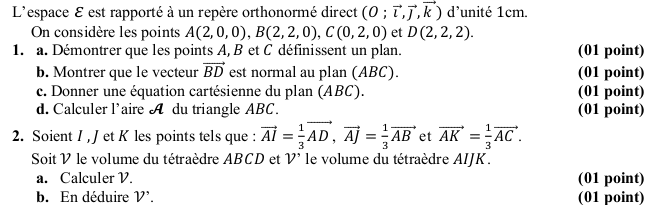
L'espace est rapporté à un repère orthonormé direct d'unité 1cm.
On considère les points et .
1. a) Nous devons démontrer que les points et définissent un plan.
Montrons que les vecteurs et ne sont pas colinéaires.
Manifestement, les vecteurs et ne sont pas colinéaires.
Dès lors, les points et ne sont pas alignés.
Par conséquent, les points et déterminent un plan.
1. b) Nous devons montrer que le vecteur est normal au plan .
Déterminons les coordonnées du vecteur .
Nous obtenons ainsi :
Dès lors, le vecteur est orthogonal à deux vecteurs et non colinéaires du plan .
Il s'ensuit que le vecteur est normal au plan .
1. c) Nous devons donner une équation cartésienne du plan .
Nous avons montré dans la question précédente que le vecteur est normal au plan .
D'où l'équation du plan est de la forme où est un nombre réel.
Nous savons que appartient à ce plan .
Donc soit
Par conséquent, une équation cartésienne du plan est , soit
1. d) Nous devons calculer l'aire du triangle .
Montrons que le triangle est rectangle en .
Nous observons que .
Dès lors, selon la réciproque du théorème de Pythagore, nous savons que le triangle est rectangle en .
Nous en déduisons que l'aire du triangle se calcule par : .
Par conséquent,
L'unité de longueur étant 1 cm, il s'ensuit que l'unité d'aire est 1 cm2. L'aire du triangle est égale à 2 cm2.
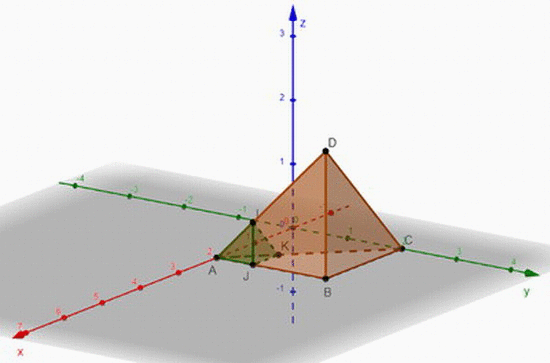
2. Soient et les points tels que :
et .
Soit le volume du tétraèdre et le volume du tétraèdre .
2. a) Nous devons calculer .
Nous savons que
Nous choisirons le triangle comme base dont l'aire est égale à 2 cm2 (voir question 1. d).
Nous avons montré que le vecteur est normal au plan .
La hauteur du tétraèdre correspondant à la base est donc .
Or .
Nous en déduisons que :
2. b) Nous devons en déduire .
Les points sont les images respectives des points par l'homothétie de centre et de rapport .
Le volume est une réduction du volume telle que .
Dès lors, nous obtenons :
6 points
exercice 2
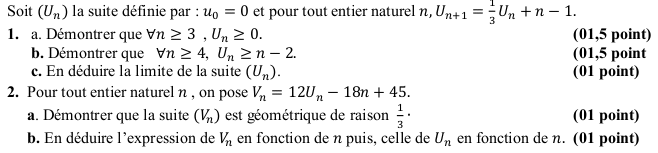
Soit la suite définie par : et pour tout entier naturel .
1. a) Démontrons par récurrence que .
Initialisation : Montrons que la propriété est vraie pour , soit que : .
En effet,
Donc l'initialisation est vraie.
Hérédité : Montrons que si pour un nombre entier naturel fixé, la propriété est vraie au rang , alors elle est encore vraie au rang .
Montrons donc que si pour un nombre entier naturel fixé, , alors .
En effet,
L'hérédité est vraie.
Puisque l'initialisation et l'hérédité sont vraies, nous avons montré par récurrence que .
1. b) Démontrons par récurrence que .
Initialisation : Montrons que la propriété est vraie pour , soit que : .
En effet,
Donc l'initialisation est vraie.
Hérédité : Montrons que si pour un nombre entier naturel fixé, la propriété est vraie au rang , alors elle est encore vraie au rang .
Montrons donc que si pour un nombre entier naturel fixé, , alors , soit .
En effet, nous avons montré dans la question précédente que .
Dès lors, pour tout entier naturel ,
L'hérédité est vraie.
Puisque l'initialisation et l'hérédité sont vraies, nous avons montré par récurrence que .
1. c) Nous devons en déduire la limite de la suite .
En utilisant le théorème de comparaison, nous obtenons :
2. Pour tout entier naturel , on pose .
2. a) Nous devons démontrer que la suite est géométrique de raison .
Pour tout entier naturel ,
Par conséquent la suite est géométrique de raison dont le premier terme est .
2. b) Nous devons en déduire l'expression de en fonction de puis, celle de en fonction de .
Le terme général de la suite est .
Dès lors, .
Nous en déduisons que :
8 points
exercice 3
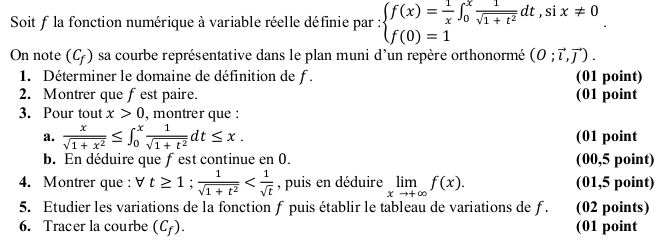
Soit la fonction numérique à variable réelle définie par .
On note sa courbe représentative dans le plan muni d'un repère orthonormé .
1. Nous devons déterminer le domaine de définition de .
La fonction est définie pour tout réel.
Donc le domaine de définition de est .
2. Nous devons montrer que est paire.
Nous devons donc montrer que pour tout .
Pour tout .
Posons .
Dans ce cas, , soit .
Analysons les bornes d'intégration.
Nous obtenons alors :
Nous en déduisons que pour tout ,
Il va de soi que
D'où .
Par conséquent, la fonction est paire.
3. a) Pour tout , nous devons montrer que :
Montrons que pour tout ,
Soit la fonction définie sur par .
La fonction est dérivable sur .
Pour tout
Nous obtenons ainsi :
Pour tout ,
Nous en déduisons que la fonction est décroissante sur .
Or .
Dès lors, la fonction est négative sur .
Par conséquent, pour tout , soit
Montrons que pour tout , .
Pour tout , pour tout ,
Par conséquent,
3. b) Montrons que est continue en 0.
En utilisant la question 3. a), nous obtenons :
De plus, comme la fonction est paire, nous obtenons :
Il s'ensuit que
Or .
Nous obtenons ainsi : .
Par conséquent, la fonction est continue en 0.
4. Nous devons montrer que : , puis en déduire .
En effet,
Nous devons en déduire .
Pour tout , pour tout , nous obtenons :
De plus, pour tout .
Par conséquent, .
En utilisant le théorème des gendarmes, nous obtenons :
5. Nous devons étudier les variations de la fonction puis établir le tableau de variations de .
La fonction est dérivable sur .
Pour tout ,
Le signe de est le signe de son numérateur car le dénominateur est strictement positif.
Nous avons montré dans la question 3. a) que pour tout .
Par conséquent, pour tout et par suite, la fonction est décroissante sur .
La fonction étant paire, il s'ensuit que est croissante sur .
Nous pouvons ainsi établir le tableau de variations de
Calcul préliminaire :
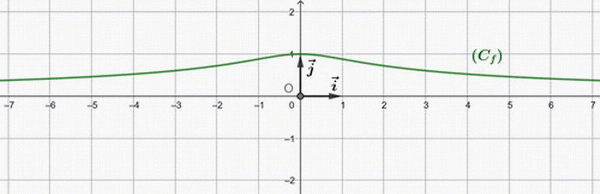
6. Nous devons tracer la courbe .
Merci à Hiphigenie et malou pour l'élaboration de cette contribution.
Publié par malou
le
ceci n'est qu'un extrait
Pour visualiser la totalité des cours vous devez vous inscrire / connecter (GRATUIT) Inscription Gratuitese connecter
Merci à Hiphigenie / malou pour avoir contribué à l'élaboration de cette fiche
Désolé, votre version d'Internet Explorer est plus que périmée ! Merci de le mettre à jour ou de télécharger Firefox ou Google Chrome pour utiliser le site. Votre ordinateur vous remerciera !

 est rapporté à un repère orthonormé direct
  }) d'unité 1cm.
d'unité 1cm., B(2,2,0), C(0,2,0) }) et
et }) .
. et
et  définissent un plan.
  et
et  ne sont pas colinéaires.
\\ B(2,2,0) \end{cases}\quad\Longrightarrow\quad\overrightarrow{AB}\,\begin{pmatrix}2-2\\ 2-0\\0-0\end{pmatrix} \quad\Longrightarrow\quad\boxed{\overrightarrow{AB}\,\begin{pmatrix}0\\ 2\\0\end{pmatrix}} \\\overset{ { \white{ _. } } } { \begin{cases} A(2,0,0)\\ C(0,2,0) \end{cases}\quad\Longrightarrow\quad\overrightarrow{AC}\,\begin{pmatrix}0-2\\2-0\\0-0\end{pmatrix} \quad\Longrightarrow\quad\boxed{\overrightarrow{AC}\,\begin{pmatrix}-2\\2\\0\end{pmatrix} }} )
 et
et  ne sont pas alignés.
 et
et  est normal au plan
  }) .
. .
.\\D(2,2,2) \end{cases}\quad\Longrightarrow\quad\overrightarrow{BD}\,\begin{pmatrix}2-2\\ 2-2\\2-0\end{pmatrix} \quad\Longrightarrow\quad\boxed{\overrightarrow{BD}\,\begin{pmatrix}0\\ 0\\2\end{pmatrix}})

+0\times2+2\times0\\=0{\white{WWtWWW}}\\ {\white{}}\end{matrix} \\\overset{ { \white{ . } } } { \phantom{ \begin{cases} \overrightarrow n \begin{pmatrix}3\\ 4\\-2\end{pmatrix} \\\end{cases}}\quad\Longrightarrow\quad \boxed{\overrightarrow {BD} \perp \overrightarrow {AC}}} )
 est orthogonal à deux vecteurs
  et
et  non colinéaires du plan
  }) .
. est normal au plan
  }) est de la forme
est de la forme  où
où  est un nombre réel.
 }) appartient à ce plan
appartient à ce plan  }) .
. soit
soit 
 , soit
 du triangle
  .
. .
.^2+2^2+0^2 \quad\Longrightarrow\quad \boxed{AC^2=8} \\\\\overrightarrow{BC}\,\begin{pmatrix}-2\\ 0\\0\end{pmatrix} \quad\Longrightarrow\quad BC^2=(-2)^2+0^2+0^2 \quad\Longrightarrow\quad \boxed{BC^2=4} )
 .
. .
.

 et
et  les points tels que :
  et
et  .
.
 le volume du tétraèdre
  et
et  le volume du tétraèdre
  .
.
 .
. .
.
 sont les images respectives des points
  par l'homothétie de centre
  et de rapport
  .
.^3\times V }) .
.^3\times V=\dfrac{1}{27}\times\dfrac 43\quad\Longrightarrow\quad \boxed{V'=\dfrac {4}{81}\,\text{cm}^3} })
 }) la suite définie par :
la suite définie par :  et pour tout entier naturel
  .
. .
. , soit que :
  .
.
} \\\overset{ { \phantom{ . } } } { \phantom{\bullet{\phantom{x}}U_2 }=-\dfrac13} \\\\\quad\Longrightarrow\quad\boxed{U_2=-\dfrac13})
+1} \\\overset{ { \phantom{ . } } } { \phantom{\bullet{\phantom{x}}U_3}=\dfrac89} \\\\\quad\Longrightarrow\quad\boxed{U_3=\dfrac89\,{\red{\geq 0}}})
 fixé, la propriété est vraie au rang
  , alors elle est encore vraie au rang
  .
. fixé,
fixé,  , alors
  .
.
 .
. , soit que :
  .
.
 fixé, la propriété est vraie au rang
  , alors
 -2 }) , soit
, soit  .
. ,
,
 \\\lim\limits_{n\to+\infty}(n-2)=+\infty \end{cases}\quad\Longrightarrow\quad \boxed{\lim\limits_{n\to+\infty}U_n=+\infty} )
 , on pose
  .
. }) est géométrique de raison
est géométrique de raison +45 \\\overset{ { \white{ . } } } { \phantom{ V_{n+1}}=12\left(\dfrac13 U_{n}+n-1\right)-18(n+1)+45} \\\overset{ { \white{ . } } } { \phantom{ V_{n+1}}=4\,U_{n}+12n-12-18n-18+45} \\\overset{ { \white{ . } } } { \phantom{ V_{n+1}}=4\,U_{n}-6n+15} )
} \\\overset{ { \white{ . } } } { \phantom{ V_{n+1}}=\dfrac 13V_n} \\\\\Longrightarrow\quad\boxed{\forall\,n\in\N,\quad V_{n+1}=\dfrac 13 V_n} \\\\\underline{\text{Remarque}}:V_0=12\,U_{0}-18\times0+45=0-0+45\quad\Longrightarrow\quad \boxed{V_0=45} )
 dont le premier terme est
  .
. en fonction de
  en fonction de
  .
.^n} }) .
.^n \end{cases}\quad\Longrightarrow\quad 12U_n-18n+45=45\times\left(\dfrac 13\right)^n \\\overset{ { \white{ . } } } { \phantom{ \begin{cases}V_n=12U_n-18n+45 \end{cases} }\quad\Longrightarrow\quad 12U_n=18n-45+45\times\left(\dfrac 13\right)^n } \\\overset{ { \white{ . } } } { \phantom{ \begin{cases}V_n=12U_n-18n+45 \end{cases} }\quad\Longrightarrow\quad U_n=\dfrac{18}{12}n-\dfrac{45}{12}+\dfrac{45}{12}\times\left(\dfrac 13\right)^n } \\\overset{ { \white{ . } } } { \phantom{ \begin{cases}V_n=12U_n-18n+45 \end{cases} }\quad\Longrightarrow\quad \boxed{U_n=\dfrac{3}{2}n-\dfrac{15}{4}+\dfrac{15}{4}\times\left(\dfrac 13\right)^n} } )
 la fonction numérique à variable réelle définie par
 =\dfrac 1x\displaystyle\int_0^x\dfrac{1}{\sqrt{1+t^2}}\,\text dt, \text{si }x\neq 0\\f(0)=1 \end{cases} }) .
. }) sa courbe représentative dans le plan muni d'un repère orthonormé
sa courbe représentative dans le plan muni d'un repère orthonormé  }) .
. réel.
réel. .
.=f(x) }) .
. Pour tout
 =\dfrac {1}{-x}\displaystyle\int_0^{-x}\dfrac{1}{\sqrt{1+t^2}}\,\text dt }) .
.  .
. , soit
  .
.
^2}}\,(-\text du) \\\\\Longrightarrow\quad \boxed{\displaystyle\int_0^{-x}\dfrac{1}{\sqrt{1+t^2}}\,\text dt=-\displaystyle\int_0^{x}\dfrac{1}{\sqrt{1+u^2}}\,\text du } )
 ,
,=\dfrac{1}{-x}\left(-\displaystyle\int_0^{x}\dfrac{1}{\sqrt{1+u^2}}\,\text du \right) \\\overset{ { \white{ . } } } { \phantom{f(-x)}=\dfrac{1}{x}\displaystyle\int_0^{x}\dfrac{1}{\sqrt{1+u^2}}\,\text du } \\\overset{ { \white{ . } } } { \phantom{f(-x)}=\dfrac{1}{x}\displaystyle\int_0^{x}\dfrac{1}{\sqrt{1+t^2}}\,\text dt\quad\text{car les variables d'intégration sont muettes } (u\text{ ou }t) } \\\overset{ { \white{ . } } } { \phantom{f(-x)}=f(x)} \\\\\Longrightarrow\quad\boxed{\forall\,x\in\R^*,\quad f(-x)=f(x)} )
=f(-0)=1. })
=f(x)} }) .
. , nous devons montrer que :
 Montrons que pour tout
 définie sur
  par
par =\dfrac{x}{\sqrt{1+x^2}}-\displaystyle\int_0^x\dfrac{1}{\sqrt{1+t^2}}\,\text dt }) .
. est dérivable sur
 =\left(\dfrac{x}{\sqrt{1+x^2}}\right)'-\left( \displaystyle\int_0^x\dfrac{1}{\sqrt{1+t^2}}\,\text dt\right)' })
'=\dfrac{x'\times \sqrt{1+x^2}-x\times (\sqrt{1+x^2})'}{1+x^2} \\\overset{ { \white{ . } } } { \phantom{ \text{Or } \left(\dfrac{x}{\sqrt{1+x^2}}\right)'}=\dfrac{1\times \sqrt{1+x^2}-x\times \dfrac{2x}{2\sqrt{1+x^2}}}{1+x^2} } \\\overset{ { \white{ . } } } { \phantom{ \text{Or } \left(\dfrac{x}{\sqrt{1+x^2}}\right)'}=\dfrac{\sqrt{1+x^2}- \dfrac{x^2}{\sqrt{1+x^2}}}{1+x^2} } \\\overset{ { \white{ . } } } { \phantom{ \text{Or } \left(\dfrac{x}{\sqrt{1+x^2}}\right)'}=\dfrac{\dfrac{1+x^2-x^2}{\sqrt{1+x^2}}}{1+x^2} } \\\overset{ { \phantom{ . } } } { \phantom{ \text{Or } \left(\dfrac{x}{\sqrt{1+x^2}}\right)'}=\dfrac{1}{(1+x^2)\sqrt{1+x^2}} } )
'=\dfrac{1}{\sqrt{1+x^2}} )
=\left(\dfrac{x}{\sqrt{1+x^2}}\right)'-\left( \displaystyle\int_0^x\dfrac{1}{\sqrt{1+t^2}}\,\text dt\right)' \\\overset{ { \white{ . } } } { \phantom{ h'(x)}=\dfrac{1}{(1+x^2)\sqrt{1+x^2}}-\dfrac{1}{\sqrt{1+x^2}}} \\\overset{ { \white{ . } } } { \phantom{ h'(x)}=\dfrac{1-(1+x^2)}{(1+x^2)\sqrt{1+x^2}}} \\\overset{ { \white{ . } } } { \phantom{ h'(x)}=\dfrac{1-1-x^2}{(1+x^2)\sqrt{1+x^2}}} \\\\\Longrightarrow\quad\boxed{\forall\,x>0,\quad h'(x)=\dfrac{-x^2}{(1+x^2)\sqrt{1+x^2}}} )
 ,
, \sqrt{1+x^2}>0 \end{cases}\quad\Longrightarrow\quad \dfrac{-x^2}{(1+x^2)\sqrt{1+x^2}}<0} \\\overset{ { \white{ . } } } { \phantom{ \begin{cases} -x^2<0\\ (1+x^2)\sqrt{1+x^2}>0 \end{cases}}\quad\Longrightarrow\quad \boxed{h'(x)<0} } )
![\overset{ { \white{ _. } } } { ]\,0\;;\;+\infty\,[ }](https://latex.ilemaths.net/latex-0.tex?\overset{ { \white{ _. } } } { ]\,0\;;\;+\infty\,[ }) .
.=0 }) .
. .
. ,
, 
 .
.![\overset{ { \white{ . } } } { t\in[0\;;\;x] }](https://latex.ilemaths.net/latex-0.tex?\overset{ { \white{ . } } } { t\in[0\;;\;x] }) ,
, 
![.\overset{ { \white{ . } } } { \phantom{ t^2\geq0}\quad\Longrightarrow\quad \displaystyle\int_0^x\dfrac{1}{\sqrt{1+t^2}}\,\text dt\leq\Big[t\Big]_0^x } \\\overset{ { \white{ . } } } { \phantom{ t^2\geq0}\quad\Longrightarrow\quad \displaystyle\int_0^x\dfrac{1}{\sqrt{1+t^2}}\,\text dt\leq x-0 } \\\overset{ { \white{ . } } } { \phantom{ t^2\geq0}\quad\Longrightarrow\quad \boxed{\displaystyle\int_0^x\dfrac{1}{\sqrt{1+t^2}}\,\text dt\leq x} }](https://latex.ilemaths.net/latex-0.tex? .\overset{ { \white{ . } } } { \phantom{ t^2\geq0}\quad\Longrightarrow\quad \displaystyle\int_0^x\dfrac{1}{\sqrt{1+t^2}}\,\text dt\leq\Big[t\Big]_0^x } \\\overset{ { \white{ . } } } { \phantom{ t^2\geq0}\quad\Longrightarrow\quad \displaystyle\int_0^x\dfrac{1}{\sqrt{1+t^2}}\,\text dt\leq x-0 } \\\overset{ { \white{ . } } } { \phantom{ t^2\geq0}\quad\Longrightarrow\quad \boxed{\displaystyle\int_0^x\dfrac{1}{\sqrt{1+t^2}}\,\text dt\leq x} } )

\leq \lim\limits_{x\to 0^+}1})
\leq 1} \\\overset{ { \white{ . } } } { \phantom{ \dfrac{x}{\sqrt{1+x^2}}\leq \displaystyle\int_0^x\dfrac{1}{\sqrt{1+t^2}}\,\text dt\leq x}\quad\Longrightarrow\quad \boxed{\lim\limits_{x\to 0^+}f(x)= 1}} )
= 1} })
= 1} })
=1 }) .
.=f(0) }}) .
. , puis en déduire
  }) .
.
 , nous obtenons :
 ![\dfrac{1}{\sqrt{1+t^2}}<\dfrac{1}{\sqrt t}\quad\Longrightarrow\quad \displaystyle\int_0^x\dfrac{1}{\sqrt{1+t^2}}\,\text dt<\displaystyle\int_0^x\dfrac{1}{\sqrt t}\,\text dt \\\overset{ { \white{ . } } } { \phantom{ \dfrac{1}{\sqrt{1+t^2}}<\dfrac{1}{\sqrt t}}\quad\Longrightarrow\quad \displaystyle\int_0^x\dfrac{1}{\sqrt{1+t^2}}\,\text dt<2\displaystyle\int_0^x\dfrac{1}{2\sqrt t}\,\text dt} \\\overset{ { \white{ . } } } { \phantom{ \dfrac{1}{\sqrt{1+t^2}}<\dfrac{1}{\sqrt t}}\quad\Longrightarrow\quad \displaystyle\int_0^x\dfrac{1}{\sqrt{1+t^2}}\,\text dt<2\Big[\sqrt t\Big]_0^x} \\\overset{ { \white{ . } } } { \phantom{ \dfrac{1}{\sqrt{1+t^2}}<\dfrac{1}{\sqrt t}}\quad\Longrightarrow\quad \displaystyle\int_0^x\dfrac{1}{\sqrt{1+t^2}}\,\text dt<2\Big(\sqrt x-\sqrt 0\Big)}](https://latex.ilemaths.net/latex-0.tex? \dfrac{1}{\sqrt{1+t^2}}<\dfrac{1}{\sqrt t}\quad\Longrightarrow\quad \displaystyle\int_0^x\dfrac{1}{\sqrt{1+t^2}}\,\text dt<\displaystyle\int_0^x\dfrac{1}{\sqrt t}\,\text dt \\\overset{ { \white{ . } } } { \phantom{ \dfrac{1}{\sqrt{1+t^2}}<\dfrac{1}{\sqrt t}}\quad\Longrightarrow\quad \displaystyle\int_0^x\dfrac{1}{\sqrt{1+t^2}}\,\text dt<2\displaystyle\int_0^x\dfrac{1}{2\sqrt t}\,\text dt} \\\overset{ { \white{ . } } } { \phantom{ \dfrac{1}{\sqrt{1+t^2}}<\dfrac{1}{\sqrt t}}\quad\Longrightarrow\quad \displaystyle\int_0^x\dfrac{1}{\sqrt{1+t^2}}\,\text dt<2\Big[\sqrt t\Big]_0^x} \\\overset{ { \white{ . } } } { \phantom{ \dfrac{1}{\sqrt{1+t^2}}<\dfrac{1}{\sqrt t}}\quad\Longrightarrow\quad \displaystyle\int_0^x\dfrac{1}{\sqrt{1+t^2}}\,\text dt<2\Big(\sqrt x-\sqrt 0\Big)} )
<\dfrac{2}{\sqrt x}} \\\\\Longrightarrow\quad\boxed{\forall\,x>0,\quad f(x)<\dfrac{2}{\sqrt x}} )
>0 }) .
.<\dfrac{2}{\sqrt x}} }) .
.<\dfrac{2}{\sqrt x}\\\lim\limits_{x\to+\infty}\dfrac{2}{\sqrt x}=0 \end{cases}\quad\Longrightarrow\quad \boxed{\lim\limits_{x\to+\infty}f(x)=0} )
 .
. est dérivable sur
  .
. ,
, =\left(\dfrac {\displaystyle\int_0^x\dfrac{1}{\sqrt{1+t^2}}\,\text dt}{x}\right)'=\dfrac{\left(\displaystyle\int_0^x\dfrac{1}{\sqrt{1+t^2}}\,\text dt\right)'\times x-\displaystyle\int_0^x\dfrac{1}{\sqrt{1+t^2}}\,\text dt\times x'}{x^2} \\\overset{ { \white{ . } } } { \phantom{ f'(x) } =\dfrac{\dfrac{1}{\sqrt{1+x^2}}\times x-\displaystyle\int_0^x\dfrac{1}{\sqrt{1+t^2}}\,\text dt\times 1}{x^2} } \\\overset{ { \white{ . } } } { \phantom{ f'(x) } =\dfrac{\dfrac{x}{\sqrt{1+x^2}}-\displaystyle\int_0^x\dfrac{1}{\sqrt{1+t^2}}\,\text dt}{x^2} } \\\\\Longrightarrow\quad\boxed{\forall\,x\in\R^*,\quad f'(x)=\dfrac{\dfrac{x}{\sqrt{1+x^2}}-\displaystyle\int_0^x\dfrac{1}{\sqrt{1+t^2}}\,\text dt}{x^2} } )
 }) est le signe de son numérateur car le dénominateur est strictement positif.
est le signe de son numérateur car le dénominateur est strictement positif. \leq 0 }) et par suite, la fonction
et par suite, la fonction ![\overset{ { \white{ _. } } } {]0\;;\;+\infty[ }](https://latex.ilemaths.net/latex-0.tex?\overset{ { \white{ _. } } } {]0\;;\;+\infty[ }) .
.![\overset{ { \white{ _. } } } { ]-\infty\;;\;0[ }](https://latex.ilemaths.net/latex-0.tex?\overset{ { \white{ _. } } } { ]-\infty\;;\;0[ }) .
.
=0\\f\text{ est paire} \end{cases}\quad\Longrightarrow\quad \boxed{\lim\limits_{x\to-\infty}f(x)=0 } })
&&+&0&-& \\ &&&&&\\\hline &&&1&& \\ f&&\nearrow&&\searrow& \\ &0&&&&0 \\ \hline \end{array})

 Voir la correction
 forum de terminale