Fiche de mathématiques
Ile mathématiques > maths bac > BAC 2025 TOUJOURS : DES SUJETS VENUS D'AILLEURS
Bac Tunisie 2025 section Sport
Durée : 2 heures
Coefficient : 1
7 points
Pour chacune des propositions suivantes, copier le numéro et répondre par vrai ou faux.
Aucune justification n'est demandée.
1.=2\ln (45)) .
.
2. > \ln\left(\dfrac{2025}{2024}\right) ) .
.
3.=-\infty) .
.
4. .
.
5. Si) est une suite géométrique de raison
est une suite géométrique de raison
 alors
alors  .
.
6. La fonction dérivée de la fonction sur
sur  est
est  .
.
7. Si) est une suite arithmétique de raison
est une suite arithmétique de raison
 alors
alors  .
.
6 points
1. Soit) la suite définie par
la suite définie par  et
et
 pour tout entier naturel
  .
.
1. a. Calculer et
et  .
.
1. b. Calculer et
et  . En déduire
que la suite n'est pas arithmétique.
. En déduire
que la suite n'est pas arithmétique.
2. On définit la suite par  pour tout entier naturel .
2. a. Montrer que la suite est géométrique de raison 2 et de
premier terme  .
.
2. b Calculer puis
puis  .
.
2. c. Exprimer en fonction de pour
tout entier naturel .
en fonction de pour
tout entier naturel .
2. d. En déduire que pour tout .
.
7 points
On considère la fonction définie sur
par
définie sur
par =\text e ^{-x}) .
.
1. a. Calculer) et
et ) .
.
1. b. Déterminer) et
et ) .
.
2. On désigne par la fonction dérivée de .
2. a. Exprimer) en fonction de
en fonction de  pour tout
réel .
pour tout
réel .
2. b. Recopier et compléter, sur votre copie, le tableau de variations de suivant :
& & - & & \\ \hline f& & ~& & \\ \hline \end{array})
3. On désigne par la courbe
représentative de la fonction dans le plan muni d'un repère
orthonormé
la courbe
représentative de la fonction dans le plan muni d'un repère
orthonormé ) .
.
3. a. Montrer que les points) et
et
) appartiennent à la courbe
.
appartiennent à la courbe
.
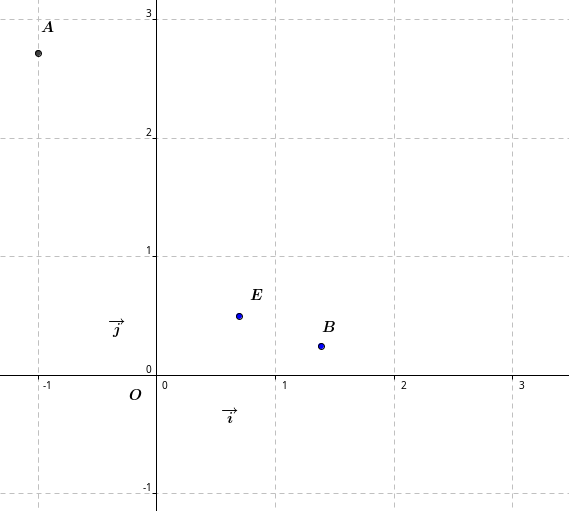
2. b On a placé les points~,~ B\left(\ln 4~,~\dfrac 14\right)) et
et ) dans le repère orthonormé
de l'annexe ci-jointe.
dans le repère orthonormé
de l'annexe ci-jointe.
Tracer la courbe dans ce repère.
ANNEXE
7 points
1.}=2\ln (45) }) .
.
 Affirmation vraie.
Nous utilisons la propriété suivante :=p\ln (x). )
Nous obtenons ainsi :
=\ln (45^2) =2\ln(45)\quad\Longrightarrow\quad\boxed{\ln(2025)=2\ln(45)} )
2. > \ln\left(\dfrac{2025}{2024}\right)}) .
.
Affirmation fausse.
En effet,
<0 \\\overset{ { \white{ _. } } } { 2025<2024\quad\Longrightarrow\quad\dfrac{2025}{2024}>1\quad\Longrightarrow\quad\ln\left(\dfrac{2025}{2024}\right)>0}\end{cases} )
Un nombre strictement négatif ne peut pas être supérieur à un nombre strictement positif.
Dès lors, l'affirmation > \ln\left(\dfrac{2025}{2024}\right)}) est fausse.
est fausse.
3.=-\infty . })
Affirmation vraie.
En effet, c'est une propriété fondamentale du logarithme népérien.
4. .
.
Affirmation fausse.
En effet,
![\displaystyle \int_0 ^2 \text e ^x ~\text dx=\Big[\text e^x\Big]_0^2=\text e^2-\text e^0=\text e^2-1\approx 6,39 \\\\\Longrightarrow \quad\boxed{\displaystyle \int_0 ^2 \text e ^x ~\text dx=\text e^2-1\approx 6,39\; {\red{\neq1}}}](https://latex.ilemaths.net/latex-0.tex? \displaystyle \int_0 ^2 \text e ^x ~\text dx=\Big[\text e^x\Big]_0^2=\text e^2-\text e^0=\text e^2-1\approx 6,39 \\\\\Longrightarrow \quad\boxed{\displaystyle \int_0 ^2 \text e ^x ~\text dx=\text e^2-1\approx 6,39\; {\red{\neq1}}} )
5. Si }) est une suite géométrique de raison
est une suite géométrique de raison  , alors
  .
.
Affirmation vraie.
En effet, si une suite }) est géométrique de raison
est géométrique de raison  telle que
  , alors
  .
.
Or la raison de la suite est  et nous savons que
  .
.
Donc nous obtenons bien : .
.
6. La fonction dérivée de la fonction sur
sur  est
est  .
.
Affirmation vraie.
En effet,
'=(-x+1)'\times \text e^{-x+1}=(-1)\times \text e^{-x+1}=-\text e^{-x+1} \\\\\Longrightarrow\quad \boxed{(\text e^{-x+1})'=-\text e^{-x+1}} })
7. Si }) est une suite arithmétique de raison
est une suite arithmétique de raison  , alors
  .
.
Affirmation fausse.
En effet, si une suite est arithmétique de raison  , alors
  .
.
La raison de la suite est  .
.
Donc .
.
Dès lors, l'affirmation est fausse.
6 points la suite définie par  et
et  pour tout entier naturel
  .
.
1. a) Nous devons calculer et
et  .
.


1. b) Nous devons calculer et
et  , puis en déduire que la suite
  }) n'est pas arithmétique.
n'est pas arithmétique.

Nous observons que la différence entre deux termes consécutifs de la suite n'est pas constante.
Par conséquent, la suite n'est pas arithmétique.
2. On définit la suite par  pour tout entier naturel
  .
.
2. a) Nous devons montrer que la suite est géométrique de raison  et de premier terme
  .
.
Pour tout entier naturel ,
 } \\\overset{ { \white{ . } } } { \phantom{ V_ {n+1}}=2U_{n}-2 } \\\overset{ { \white{ . } } } { \phantom{ V_ {n+1}}=2(U_{n}-1) } \\\overset{ { \phantom{ . } } } { \phantom{ V_ {n+1}}=2V_n } \\\\\Longrightarrow\quad\boxed{\forall\,n\in\N,\quad V_{n+1}=2V_n} )
Par conséquent, la suite est géométrique de raison  .
.
Le premier terme de cette suite est
2. b) Nous devons calculer , puis
  .
.
 Calculons .
 }) est une suite géométrique positive de raison
est une suite géométrique positive de raison  strictement supérieure à 1 et de premier terme non nul
  .
.
Dès lors, .
.
Calculons  .
.
} \\\overset{ { \white{ . } } } { \phantom{V_n=-1+U_n}\quad\Longrightarrow\quad \boxed{\lim\limits_{n\to+\infty}U_n=+\infty}\qquad\text{car }\lim\limits_{n\to+\infty}V_n=+\infty} )
2. c) Nous devons exprimer en fonction de pour tout entier naturel
  .
.
Le terme général de la suite }) est donné par
est donné par  .
.
Donc nous obtenons pour tout entier naturel ,  .
.
2. d) Nous devons en déduire que pour tout .
.
Pour tout entier naturel ,

7 points définie sur
  par
par =\text e ^{-x} }) .
.
1. a) Nous devons calculer }) et
et  }) .
.
=\text e^0\quad\Longrightarrow\quad \boxed{f(0)=1} })
=\text e^{-\ln2} \\\overset{ { \white{ . } } } { \phantom{ xxf(\ln2)}=\text e^{\ln 2^{-1}}} \\\overset{ { \phantom{ . } } } { \phantom{ xxf(\ln2)}= 2^{-1}} \\\overset{ { \phantom{ . } } } { \phantom{ xxf(\ln2)}=\dfrac 12} \\\\\quad\Longrightarrow\quad\boxed{f(\ln2)=\dfrac 12})
1. b) Nous devons déterminer }) et
et  }) .
.
Calculons .
 \\\overset{ { \white{ . } } } { \phantom{\begin{cases} \lim\limits_{x\to -\infty} -x=+\infty\\\lim\limits_{X\to +\infty} \text e^X=+\infty \end{cases}}\quad\Longrightarrow\quad \boxed{\lim\limits_{x\to -\infty} f(x)=+\infty}} )
Calculons  }) .
.
 \\\overset{ { \white{ . } } } { \phantom{\begin{cases} \lim\limits_{x\to -\infty} -x=+\infty\\\lim\limits_{X\to +\infty} \text e^X=+\infty \end{cases}}\quad\Longrightarrow\quad \boxed{\lim\limits_{x\to +\infty} f(x)=0}} )
2. a) Nous devons exprimer }) en fonction de
en fonction de  pour tout réel .
Pour tout réel , =(-x)'\times \text e^{-x}\quad\Longrightarrow\quad\boxed{f'(x)=-\,\text e^{-x}} )
2. b) Tableau de variations de :
L'exponentielle est strictement positive sur .
Nous en déduisons que = -\text e^{-x} <0 }) pour tout
pour tout  .
.
Par conséquent, la fonction est strictement décroissante sur .
Nous pouvons ainsi dresser le tableau de variations de sur .
& & &- && &\\&&&&&& \\ \hline&+\infty&&&&&\\ f& & &\searrow&& & \\&&&&&&0\\ \hline \end{array} )
3. On désigne par la courbe représentative de la fonction dans le plan muni d'un repère orthonormé
  }) .
.
3. a) Nous devons montrer que les points }) et
et  }) appartiennent à la courbe
appartiennent à la courbe  .
.
=\text e^{-(-1)}=\text e^{1}=\text e\quad\Longrightarrow\quad \boxed{A(-1\;;\;\text e)\in\mathcal C} \\\\ \overset{ { \phantom{ . } } } { \bullet}{\white{x}}f(\ln4)=\text e^{-\ln4}=\dfrac{1}{\text e^{\ln4}}=\dfrac 14\quad\Longrightarrow\quad \boxed{B\left(\ln4\;;\;\dfrac 14\right)\in\mathcal C} )
3. b) Nous devons tracer la courbe dans le repère orthonormé .

Merci à Hiphigenie et Malou pour avoir élaboré cette contribution
Publié par malou
le
Bac Tunisie 2025 section Sport
(contrôle)
Coefficient : 1
7 points
exercice 1 : QCM
Pour chacune des propositions suivantes, copier le numéro et répondre par vrai ou faux.
Aucune justification n'est demandée.
1.
2.
3.
4.
5. Si
6. La fonction dérivée de la fonction
7. Si
6 points
exercice 2
1. Soit
1. a. Calculer
1. b. Calculer
2. On définit la suite
2. a. Montrer que la suite
2. b Calculer
2. c. Exprimer
2. d. En déduire que pour tout
7 points
exercice 3
On considère la fonction
1. a. Calculer
1. b. Déterminer
2. On désigne par
2. a. Exprimer
2. b. Recopier et compléter, sur votre copie, le tableau de variations de
3. On désigne par
3. a. Montrer que les points
2. b On a placé les points
Tracer la courbe
Bac Tunisie 2025 série Sport (contrôle)
7 points
exercice 1
Pour chacune des propositions suivantes, nous devons répondre par vrai ou faux.1.
Nous utilisons la propriété suivante :
Nous obtenons ainsi :
2.
En effet,
Un nombre strictement négatif ne peut pas être supérieur à un nombre strictement positif.
Dès lors, l'affirmation
3.
En effet, c'est une propriété fondamentale du logarithme népérien.
4.
En effet,
5. Si
En effet, si une suite
Or la raison de la suite
Donc nous obtenons bien :
6. La fonction dérivée de la fonction
En effet,
7. Si
En effet, si une suite
La raison de la suite
Donc
Dès lors, l'affirmation est fausse.
6 points
exercice 2
1. Soit1. a) Nous devons calculer
1. b) Nous devons calculer
Nous observons que la différence entre deux termes consécutifs de la suite n'est pas constante.
Par conséquent, la suite
2. On définit la suite
2. a) Nous devons montrer que la suite
Pour tout entier naturel
Par conséquent, la suite
Le premier terme de cette suite est
2. b) Nous devons calculer
Dès lors,
2. c) Nous devons exprimer
Le terme général de la suite
Donc nous obtenons pour tout entier naturel
2. d) Nous devons en déduire que pour tout
Pour tout entier naturel
7 points
exercice 3
On considère la fonction1. a) Nous devons calculer
1. b) Nous devons déterminer
2. a) Nous devons exprimer
Pour tout réel
2. b) Tableau de variations de
L'exponentielle est strictement positive sur
Nous en déduisons que
Par conséquent, la fonction
Nous pouvons ainsi dresser le tableau de variations de
3. On désigne par
3. a) Nous devons montrer que les points
3. b) Nous devons tracer la courbe
ceci n'est qu'un extrait
Pour visualiser la totalité des cours vous devez vous inscrire / connecter (GRATUIT)
Inscription Gratuite se connecter
Pour visualiser la totalité des cours vous devez vous inscrire / connecter (GRATUIT)
Inscription Gratuite se connecter

 Voir la correction
 forum de terminale